
The 7 Bathroom Trends That Will Get Built in NJ in 2027
- Olive, moss, and clay color drenching (Behr's 2027 Color of the Year is an olive green)
- Curbless walk-in showers, with one real tub kept per house
- Small-format tile is back: checkerboard, zellige, visible grout
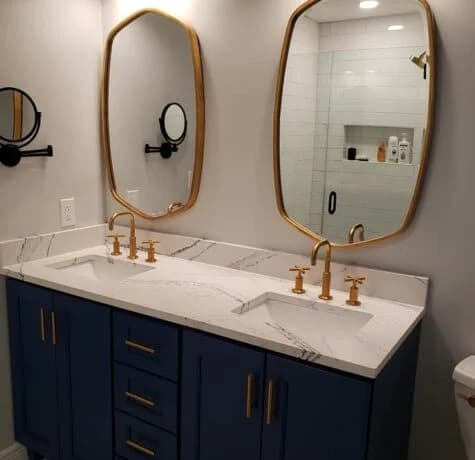
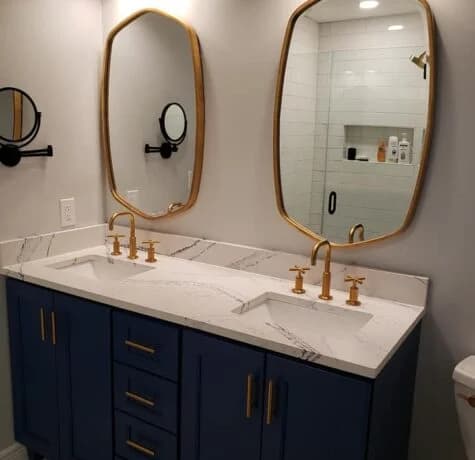
- Warm brass and champagne bronze replace matte black
- Solid-wood vanities keep beating white (28% vs 20% per Houzz)
- Wellness you actually use: heated floors, layered light, steam
- The freestanding tub returns -- only in baths of 100+ sq ft
Sources: Behr 2027 Color of the Year announcement (August 2026), Sherwin-Williams 2027 Colormix Forecast (July 2026), Houzz U.S. Bathroom Trends Study, Houzz & Home 2026, NKBA 2026 Bath Trends Report, and our own Mercer County project files.
Interactive 3D · 2027 design study
Step inside this bathroom.
Move between the wood vanity, glass shower, and freestanding tub. Look closer at the countertop and compare finishes.
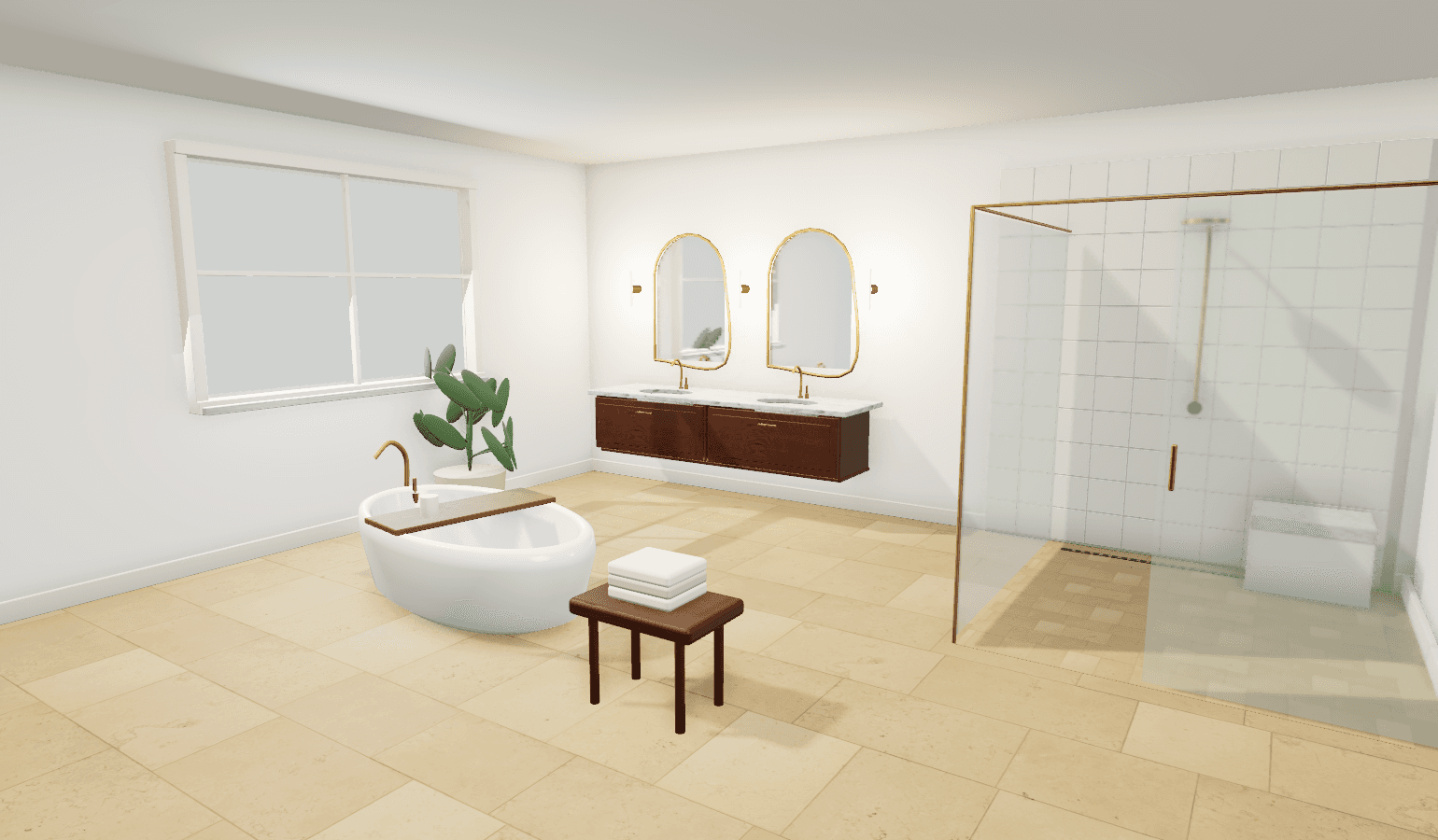
Illustrative design study. Materials and dimensions are not a measured Foreverbuilt installation. Drag to rotate, zoom in, or use the guided views.
In This Guide
- Why 2027 Is the Year Bathrooms Warm Up
- 1. Olive, Moss, and Clay Color Drenching
- 2. Curbless Showers (and the One-Tub Rule)
- 3. Small-Format Tile Is Back
- 4. Warm Metals Replace Matte Black
- 5. Solid-Wood Vanities Keep Winning
- 6. Wellness Features You Will Actually Use
- 7. The Freestanding Tub Comes Back
- What to Skip in 2027
- What a 2027 Bathroom Costs in Mercer County
- The Timeline to Finish Before 2027
- Frequently Asked Questions
Why 2027 Is the Year Bathrooms Warm Up
Every year the paint companies announce a color, the design magazines fly to Milan, and a list of "trends" lands in your feed in September. Most of it never gets built. The bathrooms that actually get installed in central New Jersey are shaped by three things the magazines do not cover: the size of the room (a lot of Mercer County baths are 5 by 8 feet), the age of the house (1950s Ewing ranches, 1970s Hamilton splits, 1990s West Windsor and Plainsboro colonials), and the resale math of the family who has to sell it in ten years.
This year the signal is unusually clear. On August 26, 2026, Behr named Grounded, a muted olive green, its 2027 Color of the Year and showed it on a bathroom vanity. A month earlier Sherwin-Williams published its 2027 Colormix forecast, Rewild: mossy greens, sun-baked clays, chalky whites, and deep oxblood. Valspar picked a mid-tone blue. Every forecast points the same direction, away from the cool gray-and-white bathroom that defined 2015 to 2022, and toward warmth, texture, and color you can feel.
We finished our 2026 bathroom trends guide with a prediction that warm neutrals and wood vanities would keep gaining. They did. What follows is the 2027 version: seven trends we are confident will be installed, not just pinned, in Mercer County next year.
1. Olive, Moss, and Clay Color Drenching
The 2027 bathroom color is green, and specifically the muddy, olive end of green. Behr's Grounded is the headline pick, and Behr's own head of color recommends it in a satin finish on cabinetry with brass hardware, which is exactly how we would spec it on a vanity. Sherwin-Williams' forecast adds the supporting cast: clay and terracotta, chalky off-white, and a cranberry-to-oxblood family that its color team expects to keep gaining through 2027.
"Color drenching," one shade carried across walls, ceiling, trim, and sometimes the vanity, is the technique the design press is pushing for 2027. It photographs beautifully. In a New Jersey powder room it also works beautifully. In a windowless 5-by-8 hall bath with an eight-foot ceiling, a fully drenched olive room feels like the inside of a jar.
Our 2027 rule: drench the powder room, accent the primary. In a primary or hall bath, put the green on the vanity or on one tile wall behind it, keep the walls a warm off-white, and let brass and wood carry the rest. That is what Houzz data supports too: 31% of renovated bathrooms now have an accent wall, and white still leads countertops at 48%.
Mercer County cost: a painted color-drenched powder room, walls and ceiling included, adds $600-$1,800 over a standard paint scope. A factory-finished olive or clay vanity in a custom or semi-custom line runs $350-$1,200 over the same cabinet in a stock neutral. Both are cheap relative to tile and easy to change in five years.
2. Curbless Showers (and the One-Tub Rule)
The 2027 trend reports disagree with each other on tubs. One says the bathtub is back at the center of the room; another lists integrated jet tubs among the things designers regret. Both are right, and neither answers the question a family in Hamilton or Robbinsville actually asks: do we keep the tub?
Here is the answer we give after 25+ years of NJ bathrooms: keep one real bathtub in the house for the buyer with toddlers, and give the primary bath a curbless walk-in shower for everyone else. Houzz reports that 68% of bathroom renovators now consider accessibility, and wet rooms have grown to 16% of renovated bathrooms. In our own projects, curbless entries are already in roughly 4 out of 10 primary bath remodels, and 2027 will be the first year they are the default rather than the upgrade.
The house decides how hard this is. A slab-on-grade Ewing ranch needs the drain recessed into concrete. A Hamilton split with joists usually lets us lower the subfloor between joists for the slope. A 1920s Trenton or Princeton home with a plank subfloor sometimes needs a short curb or a linear drain at the wall to keep the waterproofing honest. See our walk-in shower installation page for how we handle each.
Mercer County cost: converting a tub alcove to a curbless shower adds $2,500-$6,500 to a primary bath remodel depending on subfloor work. A linear trench drain is $800-$1,800 more than a center drain and is what makes the large-format floor tile possible.
3. Small-Format Tile Is Back
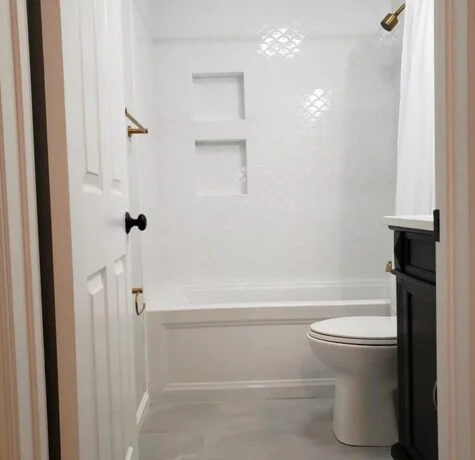
After a decade of 12-by-24 and 24-by-48 tile with grout lines hidden as much as possible, 2027 flips it. Checkerboard floors, handmade zellige, 2-by-8 offset subway in clay and sage, penny rounds, and small mosaics with a contrasting grout are in every 2027 forecast. The grout line stops being a flaw to hide and becomes part of the pattern.
The part the forecasts leave out: New Jersey water is hard, and more grout means more surface to keep clean. So we split the room. Small-format tile goes on the vanity wall, the shower back wall, or the floor as a checkerboard in porcelain (not real marble, which etches). The shower floor and the wet walls stay large-format or slab, sealed with epoxy grout, so the daily-splash surfaces are still easy. You get the 2027 look where you see it and the low-maintenance surface where you scrub it.
Zellige deserves one warning. It is gorgeous, hand-cut, and uneven by design. Order 15-20% overage, expect the installer to spend a full extra day sorting tiles, and do not put it on a shower floor. For material comparisons, our porcelain vs ceramic guide covers what holds up in a wet room.
Mercer County cost: a porcelain checkerboard floor installs at $18-$32 per sq ft. Zellige on a single feature wall runs $28-$65 per sq ft installed because of the sorting and the extra grout work. Epoxy grout adds $4-$8 per sq ft over cement grout and is worth every dollar in a shower.
4. Warm Metals Replace Matte Black
Matte black had a good run. In 2027 it becomes an accent, not the scheme. Unlacquered brass, aged brass, and champagne bronze are the fixture finishes in nearly every 2027 forecast, and they are what pair naturally with olive cabinetry and clay tile. The other 2027 move is texture contrast: a matte faucet beside a glossy tile, or a brushed-steel basin in a matte-plaster room. The forecasts call it "matte against gloss."
Practical notes from the shop: unlacquered brass will patina, which is the point, but tell the whole household before you order it. Champagne bronze is the safer pick for a hall bath that guests use. And one finish per room, two at most. A brass faucet, black towel bar, and nickel shower trim is how 2019 bathrooms got the "mixed metals" look wrong. Our hardware showroom in Ewing has all three finishes on display next to real tile so you can compare them in daylight.
5. Solid-Wood Vanities Keep Winning
Wood passed white as the top vanity finish in the Houzz Bathroom Trends Study (28% wood, 20% white), and nothing in the 2027 forecasts reverses it. White oak, walnut, and fluted or reeded fronts lead. Homeowners are also spending on the box, not just the door: 55% choose custom or semi-custom vanities and 74% specify solid wood.
The 2027 debate is floating versus floor-standing. One trend report says furniture-style floor vanities are back after a decade of wall-hung; another says floating is still the biggest seller. Our verdict for New Jersey: floating in small baths and anywhere you want a heated floor to read wall-to-wall; floor-standing furniture style in a primary bath of 80 square feet or more where the extra drawer storage matters. Either way, spec solid wood or plywood boxes, not particleboard, in a room that steams up twice a day. Our bathroom vanity lines cover both.
Mercer County cost: a solid white oak or walnut vanity runs $4,500-$9,500 installed for 36 inches and $7,500-$16,000 for a 60-inch double. Floating installation adds $400-$900 in blocking and bracket work.
6. Wellness Features You Will Actually Use
Every 2027 forecast frames the bathroom as a sanctuary. Houzz puts a number on it: 36% of renovated bathrooms now include a wellness feature, led by upgraded lighting (30%) and soaking tubs (18%). The trap is buying the features that look like wellness instead of the ones you use at 6:30 on a January morning in New Jersey.
The three that earn their cost, in order: electric radiant floor heat under the tile (used every day from November to April), layered lighting with sconces or a backlit mirror on a dimmer plus a separate ceiling fixture (used twice a day), and a steam shower generator in a primary bath that already has a sealed enclosure (used weekly). A heated towel bar is a cheap fourth.
The ones to skip: shower body sprays and jets. A designer quoted in Veranda's 2027 anti-trends list put it best: they are "shiny and exciting when installed but are rarely turned on." We have replaced enough of them to agree.
Mercer County cost: electric radiant floor heat for a primary bath is $1,200-$2,800 installed with a programmable thermostat. A layered lighting package (two sconces, backlit mirror, dimmer, separate fan) is $1,800-$4,500 including the electrical work. A steam generator with controls is $3,500-$8,500 plus the enclosure.
7. The Freestanding Tub Comes Back
The Milan-driven forecasts have the freestanding soaking tub returning to the center of the primary bath in 2027, sometimes literally in the middle of the room. In a Princeton or Hopewell primary suite of 120 square feet, that is a real option and a beautiful one. In the 60-square-foot primary bath in a 1990s West Windsor colonial, a freestanding tub eats the floor, blocks the shower door, and gets used four times a year.
Our threshold is 100 square feet. Above it, a freestanding tub plus a curbless shower is the 2027 primary bath. Below it, the shower wins and the tub lives in the hall bath (see the one-tub rule above). If you are between those two, our walk-in shower vs tub comparison walks through the resale numbers.
Mercer County cost: a freestanding acrylic soaker with a floor-mounted filler installs for $3,500-$8,500, and the floor-mounted rough-in must be planned before the subfloor goes down. Stone-resin and cast-iron tubs run higher and often need joist reinforcement.
What to Skip in 2027
Some of these are outgoing trends; some are 2027 trends that do not survive a New Jersey bathroom. We steer clients away from all of them.
- The single light bar above the mirror. It lights your forehead and shadows your face. Sconces at eye level or a backlit mirror, plus a separate ceiling light, is the 2027 standard.
- Fan-and-light combo fixtures. Designers want them gone, and so do we. A quiet, properly sized fan on its own switch is what keeps the paint and grout looking new.
- Wall-mounted faucets in a hall bath. A 2027 forecast trend, but the valve lives inside the wall. Fine in a primary bath you will own for 20 years; a serviceability headache everywhere else.
- Clay plaster or microcement in a small bath with a weak fan. Both are 2027 darlings. Both need a room that dries. In a windowless hall bath they stain.
- Vessel sinks, open shelving everywhere, and all-gray tile. These sat on the outgoing list in 2026 and are fully dated in 2027.
- Integrated jetted tubs and body sprays. See trend 6. Spend the money on radiant floor heat instead.
What a 2027 Bathroom Costs in Mercer County
Houzz reports a national median of $13,000 for all bathroom renovations and $22,000 for major remodels, with large bathrooms at $25,000. New Jersey runs higher: licensed trades, municipal permits in Ewing, Hamilton, Princeton, and Lawrence, and the surprises inside 50-to-100-year-old walls. Our installed ranges for a 2027-spec bathroom:
| Tier | Installed cost (Mercer County, 2027) | What you get |
|---|---|---|
| Powder room or small hall bath | $12,000-$25,000 | Drenched paint scheme, new wood vanity, brass fixtures, and one small-format tile wall. |
| Full primary or guest bath | $25,000-$65,000 | Curbless shower, solid-wood vanity, porcelain checkerboard or zellige feature, layered lighting, and radiant floor heat. |
| Spa-style primary bath | $65,000-$150,000+ | Wet room, freestanding tub, steam, custom vanity, and slab or full-height tile. |
Line-by-line detail is in our NJ bathroom remodel cost guide, and the resale side is in our NJ bathroom remodel ROI report.
The Timeline to Finish Before 2027
None of the 2027 forecasts mention lead times, which is the one thing that decides whether your bathroom is done for the holidays or done in March. Working backward from a mid-December finish:
- September: design and selections. Two showroom visits, a measured plan, and final tile, vanity, and fixture picks. Green and clay vanity finishes are special-order in most lines.
- Early October: order. Custom and semi-custom vanities run 6-10 weeks. Zellige and specialty tile 3-6 weeks. Freestanding tubs 2-8 weeks depending on material.
- October: permits. Mercer County towns typically turn a bathroom permit around in 2-4 weeks. We file it.
- Mid-November to mid-December: build. A full primary bath is 3-5 weeks on site; a powder room is 1-2 weeks.
Start in September and you are showering in the new room before New Year's. Start in November and you are choosing tile in January with everyone else. Our bathroom remodel timeline guide has the week-by-week version.
Frequently Asked Questions
What are the bathroom trends for 2027?
Earth-tone color drenching led by olive and moss green, curbless walk-in showers with one bathtub kept per house, small-format tile with visible grout, warm brass and champagne bronze fixtures, solid-wood vanities, wellness features that get daily use (heated floors, layered lighting, steam), and the freestanding tub returning to primary baths of 100 square feet or more.
What color is in for bathrooms in 2027?
Olive and moss green. Behr named Grounded, a muted olive, its 2027 Color of the Year and showed it on a bathroom vanity. Sherwin-Williams' 2027 forecast leans the same way with mossy greens, clay, chalky white, and oxblood accents. In Mercer County we put the green on the vanity or one tile wall and keep the walls warm off-white.
Are freestanding tubs going out of style in 2027?
No. Freestanding soaking tubs are coming back as the centerpiece of large primary baths. Integrated jetted tubs are what is going out. The rule for New Jersey resale is one real tub per house, a curbless walk-in shower in the primary, and a freestanding soaker only when the room is 100 square feet or larger.
What makes a bathroom look dated in 2027?
A single light bar above the mirror, a fan-and-light combo fixture, matte-black-everything fixtures, vessel sinks, all-gray tile with gray grout, open shelving on every wall, oval drop-in jetted tubs, and gray wood-look tile inside the shower.
Should I install a tub or a walk-in shower for resale in New Jersey?
Keep at least one bathtub in the house and convert the primary bath to a curbless walk-in shower. That satisfies buyers with young children and buyers planning to age in place. In Mercer County the tub-to-curbless conversion adds roughly $2,500-$6,500 to a primary bath remodel.
How much does a 2027-style bathroom remodel cost in Mercer County?
About $12,000-$25,000 for a powder room or small hall bath, $25,000-$65,000 for a full primary or guest bath with a curbless shower and wood vanity, and $65,000-$150,000+ for a spa-style primary with a wet room, freestanding tub, and steam.
See the 2027 Palette in Person
Olive vanities, zellige, checkerboard porcelain, and all three warm metal finishes are set up side by side in our Ewing showroom at 618 Bear Tavern Road. Bring your bathroom measurements and we will tell you which of these seven trends fits your room, what it costs installed, and whether we can finish it before 2027.
Schedule Your Free ConsultationData Sources
- Behr 2027 Color of the Year: Grounded -- announced August 26, 2026, with the accompanying 2027 palette and application guidance from Behr's color team.
- Sherwin-Williams 2027 Colormix Forecast: Rewild -- released July 30, 2026; 48 colors across three palettes.
- 2025 U.S. Houzz Bathroom Trends Study -- 1,737 renovating homeowners; vanity finishes, wet rooms, accessibility, wellness features, and spend.
- 2026 U.S. Houzz & Home Study -- 20,358 homeowners; renovation spend and 2026 plans.
- Veranda: Bathroom Features Designers Want to Leave Behind in 2027 -- June 2026 survey of NKBA and independent designers.
- Foreverbuilt Kitchens & Baths project files -- 500+ bathroom remodels completed 2022-2026 across Mercer County NJ and Bucks County PA.

Written by
Karleen Tucker
Co-Founder & Design Lead, Foreverbuilt Kitchens & Baths
Karleen co-founded Foreverbuilt with Fred Tucker in 1999 and has led the design side of the company's kitchen and bathroom remodels across Mercer County, NJ and Bucks County, PA ever since. She meets homeowners in the Ewing showroom at 618 Bear Tavern Road to select the cabinetry, countertops, tile, and hardware for every project.
More about Foreverbuilt